
The overlooked key to smaller stacks and fewer loose ends
Stop Building A Harder Tomorrow
(Office Edition) Part 1 of 4
In the early ’80s, in my first big-girl job on Wall Street, I heard an executive announce he was going paperless. With all the new technology, he was sure his desk would be 100% clear every day. A lot of people felt the same way. (For you kids, who probably are paperless, that was the Before Time, when a computer on every desk was the new frontier.)
It didn’t go so well for that executive, or many others.
It’s now 40 years later, and technology is finally catching up to the dream. Some people really are getting close.
If you’re digital-first and your desk is clear, I salute you.
But for those of us who still like to hold it, mark it up, and actually enjoy the shuffle of it, paper isn’t going anywhere yet.
Until it does, the job is eliminating the friction caused by too much paper, and the frustrating cycle of wrangling it back to order.
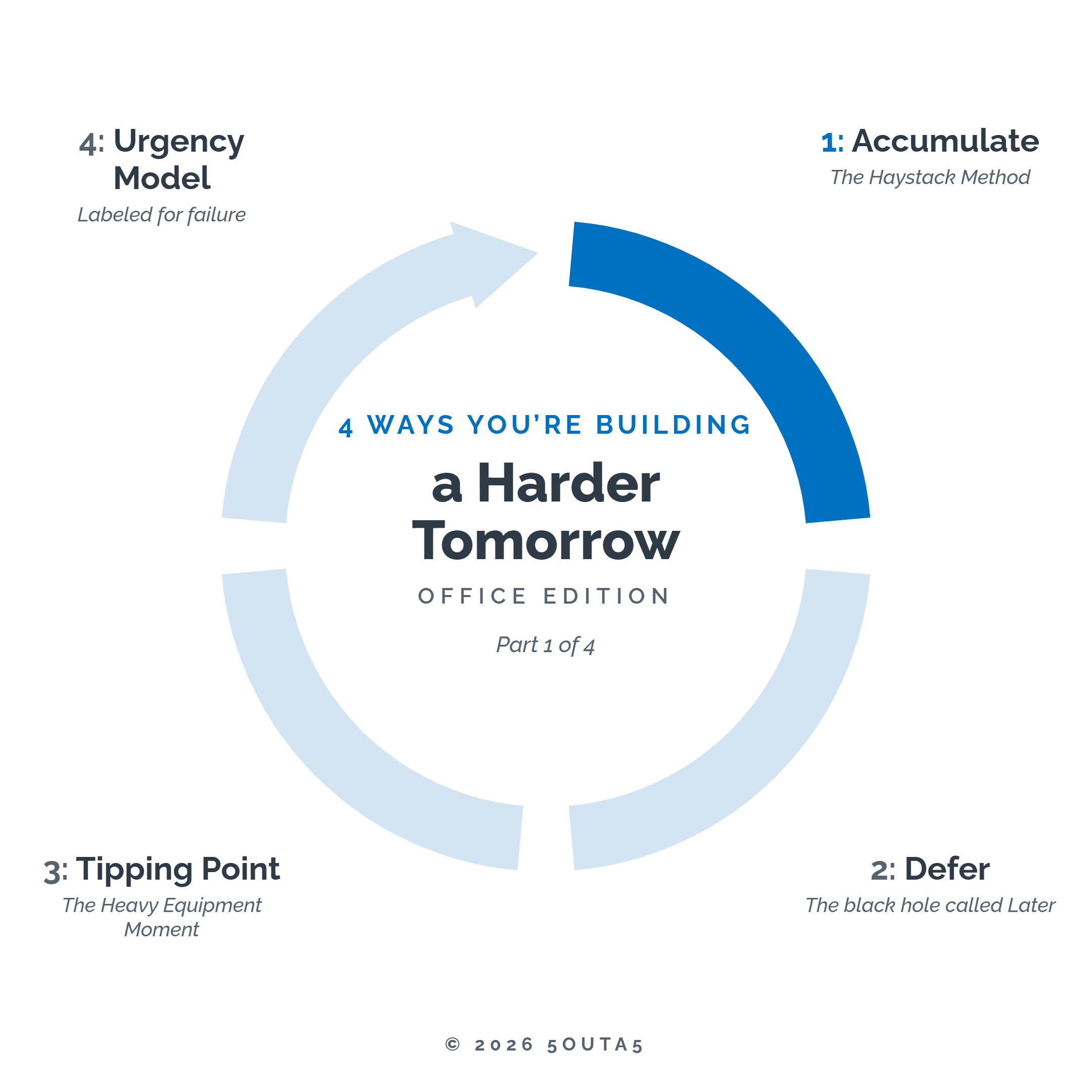
That cycle comes down to four things, involving shortcuts that add to the clutter, and ad hoc solutions that just don’t last. Think of it as steps:
1: Accumulate. The Haystack Method
2: Defer. The black hole called Later
3: Hit the Tipping Point. The Heavy Equipment Moment
4: Create an Urgency Model. Labeled for failure
Each of these four builds or sustains the clutter (and if you’ve got one, you probably have them all).
And yes, the same four apply to loose ends and open items that jam up your schedule, but that’s another article, with its own spin.
The Haystack Method
Let’s set the stage: You’re sorting the mail, or working through a client file, maybe printing out an email, and you’ve got a piece of paper in your hand.
If your first thought is “I’m gonna need this,” it’s usually followed by the question: “Where should this go?” or “Where should I put this?”
And because you don’t have a consistent answer,
the under-the-radar decision is:
“I’ll just put it here for now.”
Congratulations. You’ve just used a little something I call the Haystack Method: a shortcut that seems fast but turns into a commingled collection of important tasks, good ideas, things for someday, the not-so-important- you get the idea.
Fast but not functional is a recipe for spending more time.
The trouble is everything that comes after: remembering what that paper said, forgetting which stack it went into, and finding it quickly when you need it.
Untangling the stacks later is a bigger job (read: more time), and in the meantime, watching them grow brings more stress, more searching, and more frustration.
FOF Syndrome
In all those years with clients, I’ve rarely met anyone who avoids filing because they’re lazy.
They avoid it because of FOF: the Fear of Filing.
And the Fear of Filing is really the fear of not finding.
Here’s what skipping a functional system costs you. While you can certainly see all the paper, finding what’s important in the moment can turn into an archaeological dig, a treasure hunt that can chew up an afternoon.
Somewhere in there: the phone number on a Post-it (or was it on a legal pad?), the perfect handwritten notes for this afternoon’s client call, the bill that needs to be reviewed and paid today.
(Insert your latest search-party example.)
Why the focus on filing? Because much of what’s in those stacks doesn’t need action at all. It needs a home.
My guesstimate for the share of paper already on the desk that should be filed? I’d say a safe 50%.
Don’t quote me, but I think that’s the low side. Not to mention what belongs in the shredder.
Let’s experiment.
Pick one short stack. Just one. Sort it into three piles:
1. Needs action (now or soon)
2. Needs a home (aka file or forward)
3. Shredder or toss
Here’s a peek into my triage method: do a rough pass, and read only enough to know which pile each paper belongs in.
Tempting as it may be, stay out of rabbit-hole mode; this is a sort, not a catch-up session. Then count, or eyeball it.
Do the shredder pile and the “needs a home” pile compete for biggest?
Whatever you discover, keep it in mind the next time you’re about to “just put it here for now.”
Are you a piler or a filer?
Researchers have been studying this longer than you might think. In 1983, Thomas Malone at MIT looked at how people actually organize their desks.
He found two approaches: files, which are labeled and ordered, and piles, which are neither.
Here’s the part I love. The piles weren’t laziness. They were doing a job. A visible stack works as a reminder, of sorts, and it lets you put off the hardest part of the whole process: deciding which category a paper belongs in.
What’s missing is a reliable way of filing and finding: the trusted system David Allen talks about.
There’s a reason the pile feels safer, too. Memory research has shown for decades that recognizing something when you see it is far easier than recalling it with no prompt.
Paper in plain sight gets recognized. Paper in a drawer has to be recalled.
But visibility cuts both ways. As a visual, it hits immediately and can color your entire day.
Those stacks are sirens on the rocks, calling for your attention. Bye-bye, bandwidth.
So who wins?
If you’ve been feeling guilty about being a piler, here’s some relief: later research comparing pilers and filers found that neither came out clearly ahead.
Filing everything isn’t the answer either. A drawer full of folders you can’t make sense of is just a horizontal haystack: same mess, better posture.
So the real cause isn’t a filing problem. It’s the absence of meaningful categories: categories that reflect your business model needs.
Here’s the good news: you already have that framework. It’s hiding in plain sight. When every paper has a useful category, aka a consistent, reliable home, the decision takes seconds and the fear of not finding goes away.
My Clutter Creep Crash Course starts with that premise and provides the immediate solution: the answer to “Where should this go?”
Adding’s first cousin: Keeping
Keeping has its own logic. Some of it has a real business case. A lot of it is just in case: it might be useful someday, or it was useful once.
I had a client with a shelf of dated almanacs right next to the desk, which is prime real estate, because six years earlier someone had called with a question and one of those books had the answer. The almanacs were ready. They had been ready for six years.
A few of the usual suspects:
● The office as the catch-all for anything that needs “doing”: the catalogue, the invitation, the article you’ll read someday.
● Not yet, but let’s be ready: the materials for the project you’re definitely starting soon.
● Keeping by avoidance: the conference binder from 2019, or the manual from two printers ago. (Don’t get me started on power cords.)
Ground zero
Every one of these is a small, sensible decision that takes seconds. That’s exactly why they’re so good at building a harder tomorrow.
Each haystack is ground zero for what I call cacophony mode: you walk into the office, and the noise starts before you’ve done a thing.
Notice what all of these decisions have in common. They send the paper to the same place. “For now,” it turns out, has a remarkable shelf life. Its forwarding address is Later.
PART 2 PREVIEW: Same issue, different flavor – the task-side backlog
That framework hiding in plain sight? Finding it is where the Clutter Creep Crash Course begins.
Kathleen Day is an efficiency coach and the founder of 5OUTA5. With more than 15 years of experience, she’s many times past her 10,000 hours in offices, corporate and home alike. Corner office or nook in the attic, she believes your workspace is where you build your empire, and she has the solutions to make it high-performance.